

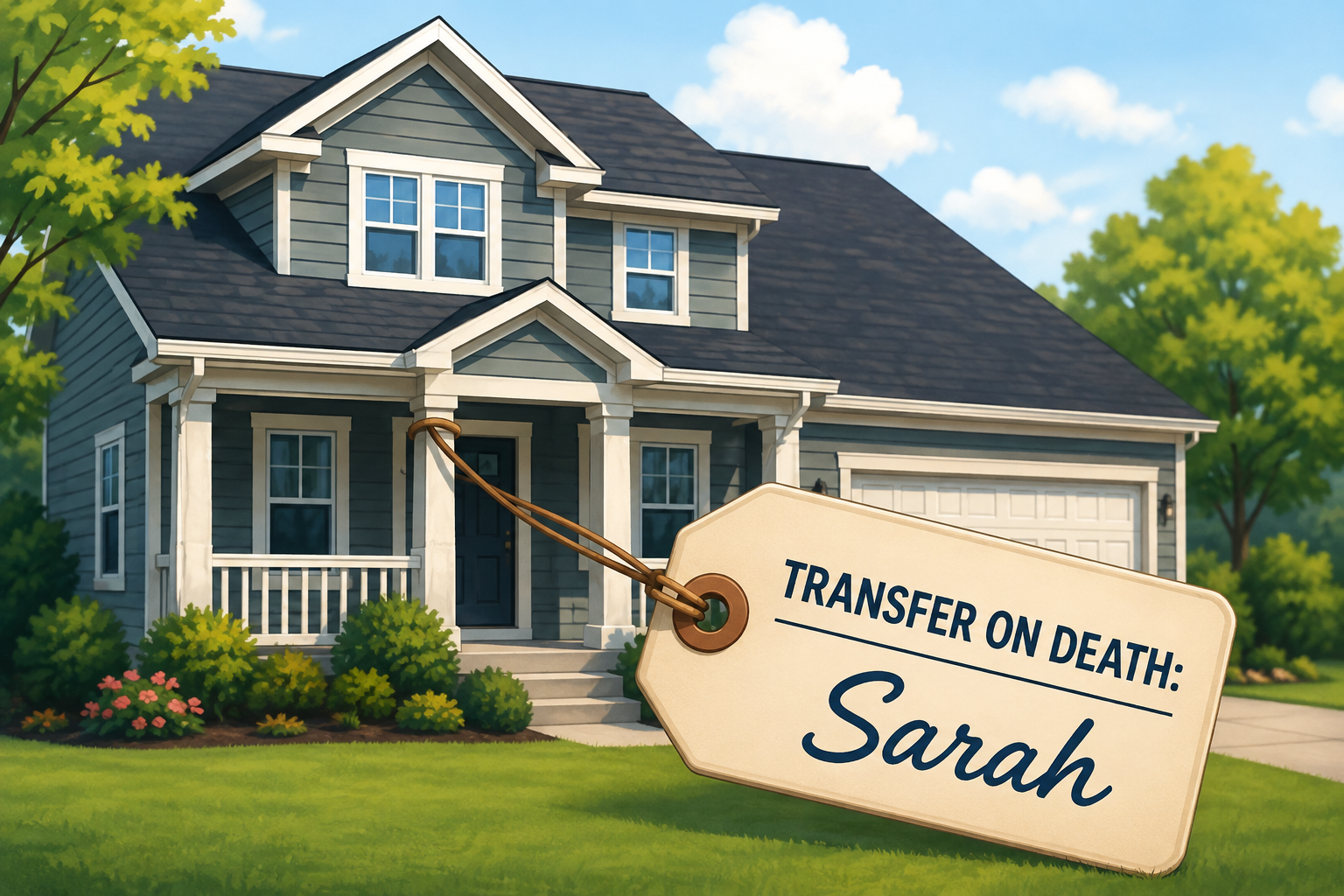
Maryland’s New Transfer-on-Death Deed: A Simple New Estate Planning Tool — But Not a Substitute for a Plan
Beginning October 1, 2026, Maryland homeowners will have a new estate planning option. It is called a Transfer-on-Death Deed, or TOD Deed.
The basic idea is pretty simple:
- You own your house.
- You sign and record a deed naming the person or people who should receive the property when you die.
- You remain the owner while you are alive.
- And when you die, the property passes automatically to the person named in the TOD Deed, without having to pass through probate.
For a lot of Maryland homeowners, this could be a very useful tool. But like most things in estate planning, “simple” does not necessarily mean “right for everyone.” And there is one rule that is particularly important to understand: Your Will does not override your TOD Deed. More on that below.
What Is a Transfer-on-Death Deed?
In May 2026, Governor Wes Moore signed the Maryland Transfer-on-Death Deed Act into law. The law takes effect October 1, 2026. Under the new law, a property owner can execute a deed naming one or more beneficiaries who will receive the property when the owner dies.
This is similar in concept to putting a beneficiary designation on a bank account.
If you have a bank account that says “Payable on Death to Sally,” you still own the account while you are alive. Sally does not get to withdraw your money. She does not get to tell you how to invest it. And you can change the beneficiary designation. But if Sally is still the beneficiary when you die, the account passes to Sally.
A TOD Deed brings a similar concept to Maryland real estate. You Still Own Your House. This is an important distinction between a TOD Deed and simply adding someone to the title of your property.
If you name your daughter as the beneficiary of your TOD Deed, your daughter does not become a co-owner of your house. In fact, the statute specifically says that during your lifetime the TOD Deed does not create a legal or equitable interest in the beneficiary.
- You remain the owner.
- You can sell the house.
- You can refinance it.
- You can mortgage it.
- You can change the beneficiary.
- You can revoke the TOD Deed entirely.
And you do not need the beneficiary’s permission to do those things.
That is one of the biggest advantages of the new law.
Previously, Maryland homeowners who wanted their property to pass outside probate sometimes used life estate deeds. Those can still be useful, but they are more complicated and, depending upon how they are drafted, can affect the owner’s rights during life.
A TOD Deed is intended to provide a simpler alternative. The Maryland government’s own explanation describes the form as designed to use non-legal terminology and be intuitive for non-lawyers, while also cautioning that TOD Deeds are not the right tool for every situation.
The Deed Has to Be Recorded
Signing a TOD Deed and putting it in your desk drawer does not work. The deed must be recorded in the Land Records of the county where the property is located before the owner dies.
That last part matters. Estate planning documents have rules. Almost signing something is not the same as signing it. Signing something that needed witnesses but forgetting the witnesses can be a problem. And signing a TOD Deed but never recording it is not going to accomplish what you intended.
What Happens When You Die?
This is where the new law becomes particularly powerful.
If the TOD Deed is valid and still in effect when you die, the transfer occurs at your death. Not six months later. Not when probate closes. Not when your Personal Representative distributes the house. The TOD Deed transfers the property at death.
The statute even provides a procedure for recording notice of the owner’s death, but specifically says that the notice is not required to make the transfer happen. The transfer is deemed to have occurred at the owner’s death.
That means the house does not become an asset that your Personal Representative has to distribute through your probate estate.
Which brings us to something I expect will cause confusion.
Your Will Does Not Override Your TOD Deed
Imagine that you own a house in Maryland. You execute and record a TOD Deed that says: When I die, my house goes to my daughter, Sarah. Five years later, you sign a new Will. The Will says: I leave my house to my son, Michael.
Who gets the house? Assuming the TOD Deed remains valid and no other statutory exception applies, Sarah gets the house. Why? Because when you die, ownership passes under the TOD Deed. A TOD Deed takes precedent over your Will.
Maryland expressly classifies the TOD transfer as “non-testamentary,” meaning it is not a transfer made through your Will. More importantly, the new law specifically says that once a TOD Deed has been recorded, it cannot be revoked by a testamentary document even if that document was signed after the TOD Deed was recorded.
So writing a new Will does not quietly erase the old TOD Deed. This is the same general concept people already encounter with beneficiary designations.
Your Will might say, “I leave everything equally to my three children.” But if your $500,000 life insurance policy names only one child as beneficiary, the Will generally does not divide that policy three ways. The TOD beneficiary designation controls the disposition of that asset.
The TOD Deed works similarly.
Estate planning is not just about what your Will says. It is about how all of your assets are actually structured to pass at death.
What if You Change Your Mind?
Fortunately, a TOD Deed is revocable. If you name Sarah today and later decide that you want the property to go to Michael instead, you can change the plan. But you need to change it properly.
The statute provides methods for revoking or replacing the TOD Deed, including recording a new TOD Deed or an instrument of revocation. A later lifetime conveyance of the property can also affect or revoke the TOD arrangement.
Do not assume: “I changed my Will, so I’m good.” You may not be. This is exactly why beneficiary designations, deeds, account titles, Wills, and Trusts should be reviewed as parts of one estate plan rather than as unrelated documents.
A TOD Deed Can Be Great for a Simple Plan
Suppose Dad owns his house. He has one daughter. His plan is simple: “When I die, I want my daughter to own my house.” Dad does not need to give his daughter any rights to the property while he is alive. He does not want the house going through probate. He does not have complicated instructions about what happens after his death. That may be an excellent situation for a TOD Deed.
Or imagine Mom has three children and simply wants all three children to own the property after she dies. A TOD Deed may provide a relatively simple way to accomplish that without requiring the property itself to pass through probate. The law even allows multiple beneficiaries and allows the deed to specify how those beneficiaries will own the property.
But notice the important word in both examples: Simple.
A TOD Deed Is Not a Replacement for a Trust
This is where I think people need to be careful.

Avoiding probate and accomplishing your estate planning goals are not necessarily the same thing.
A TOD Deed can be excellent at answering this question: Who owns my house after I die?
But many estate plans need to answer more complicated questions. For example:
- “I want my daughter to have the first opportunity to buy the house before it is sold.”
- “I want my son to be allowed to live in the house for six months after I die so that he has time to find somewhere else to live.”
- “My daughter can live in the house for the rest of her life, but when she dies I want the property to go to my grandchildren.”
- “I want my three children to inherit equally, but I want one child to have the option to purchase the other children’s interests.”
- “My son is terrible with money. I want him to benefit from the house, but I do not want him to immediately own it outright and be able to sell it.”
Those are very different instructions from: “Give the house to Sarah when I die.”
A TOD Deed transfers ownership. A properly drafted Trust can create rules for what happens after your death. That distinction matters. If your goal is simply to transfer the house to someone when you die, a TOD Deed may be exactly what you need.
If your goal is to control how the property is used, when it can be sold, who can live there, who gets an opportunity to purchase it, or what ultimately happens to the property after the first beneficiary dies, a TOD Deed by itself may be inadequate.
That does not make TOD Deeds bad. It just means they are a tool. And no single estate planning tool is right for every job.
What If the Beneficiary Dies Before You?
This is another reason not to treat the beneficiary designation casually. Maryland’s new law allows the TOD Deed to name alternate beneficiaries. If the primary beneficiary dies before the owner, the property can pass to a surviving alternate beneficiary identified in the deed. The statute also provides that the interest of a beneficiary who fails to survive the owner generally lapses.
So consider this: You name your son as the TOD beneficiary. Ten years pass. Unfortunately, your son dies before you, leaving two children of his own. Do you want the house to go to your son’s children? To your other children? To someone else?
That is the type of question that should be answered when the deed is prepared rather than left for your family to figure out later.
The Beneficiary Takes the Property as It Exists
A TOD Deed also does not magically clean up the property. If there is a mortgage, lien, or other encumbrance against the property when you die, the beneficiary generally takes the property subject to it.
So “I left my daughter my $600,000 house” may actually mean: “I left my daughter a $600,000 house with a $275,000 mortgage.” Those are not quite the same gift.
Again, estate planning works best when we look at the whole picture.
Another Tool in the Estate Planning Toolbox
I like Maryland’s new TOD Deed law. For the right person, it provides a simple and potentially inexpensive way to keep a home out of probate while allowing the owner to maintain complete control during life.
And importantly, using a TOD Deed does not mean that everyone should suddenly rush out and put their house into a Trust. I do not believe everyone needs a Trust, but I also do not believe everyone needs a TOD Deed. The question is what you are actually trying to accomplish.
If the answer is: “When I die, I want this person to own my house” then a TOD Deed may be an excellent solution.
But if the answer begins: “When I die, I want my daughter to be able to live there, but…” or “I want my son to have the first option to buy it, and then…” or “I want my children to receive it equally, except…” then we probably need to keep talking so that we can put together a real plan.
Because everything after the word “but” is where estate planning usually gets interesting.
Final Thoughts
Maryland’s new Transfer-on-Death Deed gives homeowners another way to plan for what happens to their real estate after death. That is a good thing.
A TOD Deed can avoid probate for the property, preserve the owner’s control during life, and provide a relatively straightforward transfer at death. But it needs to fit with the rest of the estate plan. Your Will does not override it. Your beneficiary needs to be chosen carefully. Alternate beneficiaries should be considered.
And if your wishes involve anything more complicated than transferring outright ownership at death, you should consider whether a Trust or another planning strategy is better suited to accomplish those goals.
Estate planning is not about collecting documents. It is about making sure the documents, deeds, beneficiary designations, account titles, and actual assets all tell the same story. Maryland has just given us one more useful way to tell that story.










Leave A Comment