

Mr. Krabs loves money. He also loves the Krusty Krab.
So, let’s assume that at some point Mr. Krabs did something surprisingly responsible: he formed Krusty Krab, LLC to own and operate the Krusty Krab.
Years later, Mr. Krabs finally decides to do some estate planning. He creates a revocable living trust. He wants to avoid probate and make things easier for Pearl when he dies. His house goes into the trust. His bank accounts are coordinated with the trust. Everything seems pretty straightforward.
Then he gets to the Krusty Krab. Should he transfer the restaurant into his trust? Or should he transfer Krusty Krab, LLC into his trust?
Those sound like two ways of doing the same thing.
They aren’t.
And this is where estate planning for people who own LLCs can get a little more complicated.
The LLC and the Property It Owns Are Not the Same Thing
Suppose you own a rental property.
A few years ago, you formed an LLC and transferred the rental property into it.
Today, the deed does not say: John Smith
It says: Smith Properties, LLC
That distinction matters.
You own the LLC. The LLC owns the house.
Think of it as a box. The rental property is inside the box. You own the box.
When we create your estate plan, we need to decide what to do with the box, not automatically start pulling things out of it. That is particularly important when you create a revocable living trust.
Why Not Just Put the Rental Property in the Trust?
This is a question I occasionally encounter when reviewing an estate plan. A client owns a rental property through an LLC. The client also has a revocable living trust.
Somebody says: “We’re putting everything into the trust, so let’s deed the rental property from the LLC into the trust.”
Not so fast. The LLC and the revocable trust are doing different jobs. An LLC may have been created, among other reasons, to create some separation between the owner and the rental property and its liabilities.
A revocable living trust generally isn’t an asset-protection device. Its primary estate-planning purposes are things like avoiding probate, providing for management of assets during incapacity, and controlling how assets are administered after death.
Moving the rental property out of the LLC and into the trust may therefore solve one estate-planning problem while undermining a reason the LLC was created in the first place.
Mr. Krabs would probably be horrified to discover that, in an effort to simplify his estate plan, he had accidentally given up a layer of protection he was already paying for.
Fortunately, there may be another option.
What If the Trust Owns the LLC?
Go back to our box.
The Krusty Krab is inside Krusty Krab, LLC.
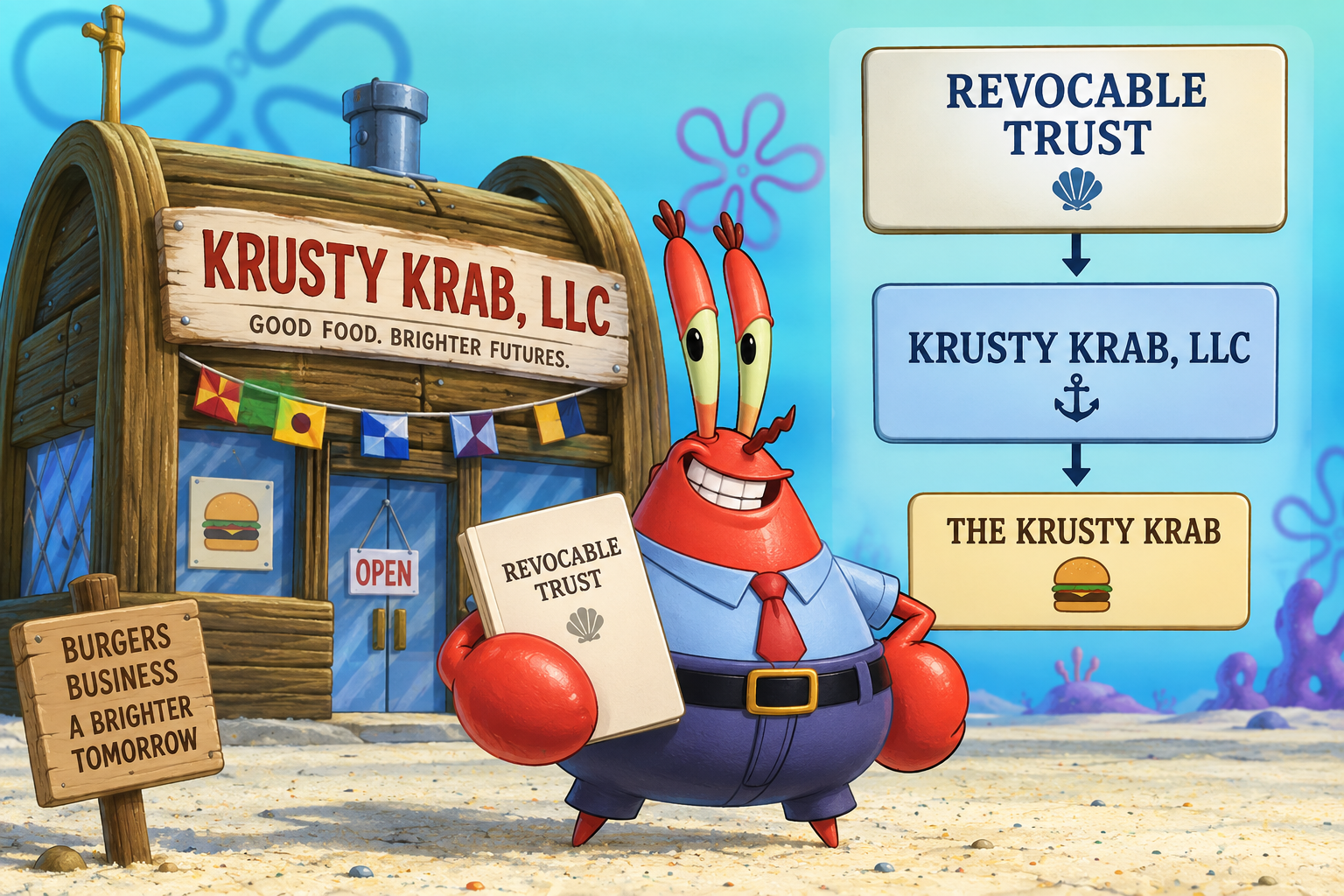
Instead of pulling the Krusty Krab out of the LLC and transferring the restaurant itself into Mr. Krabs’s trust, we may be able to transfer Mr. Krabs’s ownership interest in Krusty Krab, LLC to the trust.
Now the structure looks something like this:
Mr. Krabs’s Revocable Trust → Krusty Krab, LLC → The Krusty Krab
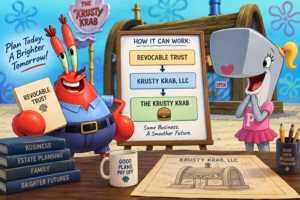
The restaurant stays where it was.
The LLC still owns it. But Mr. Krabs’s trust now owns the LLC.
For many clients, this can be an elegant way to coordinate an LLC with a trust-based estate plan. The LLC can continue to serve its business purpose while the trust can address what happens to Mr. Krabs’s ownership interest if he becomes incapacitated or dies.
In other words, you don’t necessarily have to choose between an LLC and a trust.
They can work together.
Of course, that doesn’t mean everyone with an LLC should immediately transfer it to a revocable trust. The LLC’s operating agreement, ownership structure, tax treatment, other members, financing arrangements, and the client’s overall objectives all need to be considered.
But it does mean that “put everything into the trust” isn’t quite as simple as it sounds when an LLC is involved.
What If I Don’t Have a Trust?
This issue isn’t limited to trust-based estate plans.
Suppose Mr. Krabs doesn’t want a trust. Instead, he signs a Will saying that when he dies, Pearl gets everything he owns. Does Pearl get the Krusty Krab? Well, sort of.
Remember what Mr. Krabs actually owns. He doesn’t personally own the restaurant if the restaurant belongs to Krusty Krab, LLC. He owns an interest in the LLC. That LLC interest is what his estate plan needs to address. And that brings us to another issue that business owners sometimes overlook.
Inheriting the Business and Running the Business May Be Two Different Things
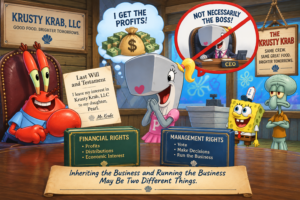
Let’s say Mr. Krabs’s Will leaves his interest in Krusty Krab, LLC to Pearl. Problem solved? Maybe not.
An LLC ownership interest can include different rights. One set of rights involves the financial side of the company (i.e., the right to receive profits and distributions). Another involves control (i.e., the right to vote, make decisions, and participate in managing the company). Those rights don’t always travel together automatically.
So Pearl might be entitled to receive the economic benefit of Mr. Krabs’s LLC interest without necessarily having an automatic right to walk into the Krusty Krab the next morning, fire Squidward, give SpongeBob a raise, and start running the place.
Whether she can do that may depend on the LLC’s operating agreement and the circumstances surrounding the transfer. For a single-member LLC, the situation may be simpler than it is for a business with multiple owners. But the larger point is the same: Your Will or Trust is only one part of the plan.

Don’t Forget the Operating Agreement
This is one of the reasons I want to see the operating agreement when a client tells me that he or she owns an LLC.
Imagine an LLC owned by three friends. Their operating agreement says that an ownership interest cannot be transferred to someone else without the consent of the other members. Then one of the owners creates an estate plan saying: “When I die, my daughter gets my LLC interest.” Those two documents need to be coordinated.
An estate plan cannot magically give a beneficiary rights that are restricted by the company’s governing documents. The same concern can arise during incapacity.
Suppose you are the only person currently authorized to manage your LLC. You have a revocable trust and a successor trustee who can step in and manage your trust assets if you become incapacitated.
Great. But can that successor trustee actually exercise your rights in the LLC? That is a question worth answering before you become incapacitated. The goal isn’t simply to have a Will, a Trust, and an operating agreement sitting in three different folders. The goal is for them to work together.
This Matters for More Than Rental Properties
Rental properties are an easy example because many of my clients own real estate through LLCs. But the same basic planning issue can arise with all kinds of businesses.
Maybe you own a consulting company.
Maybe you own a medical practice.
Maybe you and a friend own a small business together.
Maybe your LLC owns several rental properties.
Maybe you formed an LLC years ago, put something valuable inside it, and haven’t looked at the operating agreement since.
Whatever the situation, the LLC needs to be part of the estate-planning conversation. One of the first questions is deceptively simple: What do you actually own?
If an LLC owns the property, then your estate-planning asset may not be the property itself. It may be your ownership interest in the LLC.
“My Kids Will Figure It Out” Isn’t Much of a Succession Plan
Business owners are often very good at planning for the problems they encounter while they are alive.
They form LLCs.
They buy insurance.
They sign contracts.
They hire accountants.
They keep separate bank accounts.
They worry about taxes and liability.
But sometimes very little thought is given to what happens to the company if the owner dies or, just as importantly, becomes incapacitated.
Who runs it?
Who receives the income?
Can the business continue operating?
Can someone sign a lease?
Can someone deal with the bank?
Can someone sell the property?
Do your children inherit the company equally?
Does one child run it while all three children own it?
What happens if one child wants to sell and another wants to keep it?
Those aren’t really LLC questions. They’re estate-planning questions. And the best time to answer them is while the person who built the business is still here to answer them.
The Bigger Estate-Planning Lesson
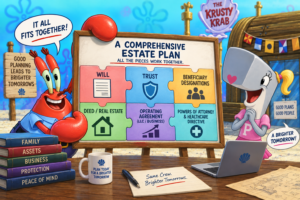
There is a larger lesson here that goes beyond LLCs. Estate planning isn’t just about signing a Will or creating a Trust. It is about making sure that everything works together.
Your Will says one thing. Your Trust says another. Your beneficiary designations say something else. Your deed tells us who owns the real estate. And, if you own a business, your operating agreement may have something important to say about what happens to your ownership interest.
All of those pieces need to tell the same story.
So, if you own an LLC, your estate plan needs to answer more than: “Who gets my company when I die?”
It should also answer:
Who can run it?
Who receives the income?
What happens to the property it owns?
Who can step in if I become incapacitated?
And does the operating agreement actually allow the plan I just created?
Owning an LLC doesn’t make estate planning impossible. It just means the LLC needs to be part of the plan.
Even Mr. Krabs should understand that. Although convincing him to pay an attorney to review it may be the harder part.







Leave A Comment