


There is a famous scene from The Office where Michael Scott walks into the office and announces: “I DECLARE BANKRUPTCY!”
Oscar then has to explain that bankruptcy does not quite work that way. Michael’s response is classic Michael Scott: “I didn’t say it. I declared it.”
Unfortunately, there is an estate-planning version of the same mistake. I hear some variation of it all the time:
- “If something happens to me, my wife can handle everything.”
- “My daughter takes care of all that stuff anyway.”
- “My oldest son is in charge.”
- “My kids know what I want.”
That’s great. But did you actually give that person legal authority to act for you? Because you cannot simply declare your daughter in charge.

Meet Dwight Schrute, Family Financial Manager
Imagine Dad is 78. He lives independently. He pays his own bills. He has a checking account, an investment account, a car, and a house in his own name. His daughter, Sarah, lives nearby and helps him with things from time to time.
Sarah is the Dwight Schrute of the family. She is responsible. She is organized. She knows where Dad keeps the tax returns. She has the accountant’s phone number. She knows when the property taxes are due. She probably has a spreadsheet. If something happens to Dad, everyone knows Sarah is the one who will take care of things.
Then Dad has a major stroke. He survives, but he can no longer manage his finances. The mortgage still needs to be paid. The electric bill still arrives. His investment account needs attention. Maybe the house needs to be sold so Dad can move into an assisted-living facility.
No problem. Sarah is ready. Sarah walks into Dad’s bank and explains what happened. “My father had a stroke. I’m his daughter. I handle his finances. I need access to his account so I can pay his bills.” The bank asks for her Power of Attorney.
Sarah doesn’t have one.
And suddenly Sarah discovers that she is not Assistant Regional Manager. She is Assistant to the Regional Manager. Big difference.

Being the Responsible Child Does Not Give You Legal Authority
This surprises people.
Under Maryland law, a spouse, adult child, or other relative does not automatically acquire authority over another person’s individually owned property simply because that person becomes incapacitated. And it is not just limited to your adult children or siblings. It also applies to spouses.
Your wife does not automatically become your financial agent.
Your husband does not automatically become your financial agent.
Your oldest child does not automatically become your financial agent.
And your most responsible, organized, Dwight-Schrute-level-prepared child does not automatically become your financial agent.

Even if everyone in the family agrees. Even if that child has been helping you for years. Even if everyone knows exactly what you would want. If the bank account belongs to Dad, it is still Dad’s bank account. If the house belongs to Dad, it is still Dad’s house.
Sarah cannot simply walk into the bank and withdraw Dad’s money because she is his daughter. She cannot automatically sign contracts for him. She cannot automatically sell his house.
And she cannot stand in the middle of the bank and announce: “I DECLARE MYSELF DAD’S FINANCIAL AGENT!”
Michael Scott taught us how that works. Saying it louder does not help.
That Is What a Power of Attorney Does
A financial Power of Attorney allows you—the principal—to designate another person—your agent—to act on your behalf.
Depending upon the authority you give your agent, that person may be able to do things such as:
- Deal with banks and financial institutions.
- Pay bills.
- Manage investments.
- Handle insurance matters.
- Sign contracts.
- Deal with real estate.
- Manage other financial and property matters on your behalf.
And a durable Power of Attorney can continue to work even after you become incapacitated. That last part is enormously important.
The document you sign while you are healthy may become most valuable when you are no longer capable of handling these things yourself. Think of it as actually making Dwight the Assistant Regional Manager. You are not merely telling everyone he is in charge. You are giving him the authority to do the job.

The Catch: You Have to Sign It Before You Need It
This is where families sometimes get into trouble. Go back to Dad. Dad has the stroke. Sarah goes to the bank. The bank asks for a Power of Attorney. Sarah doesn’t have one. So Sarah calls an estate-planning attorney and says: “No problem. Can you prepare a Power of Attorney for Dad?”
Maybe. But now we have another question: Does Dad still have the capacity to execute one?
A Power of Attorney is not something your family can simply create for you after you become incapacitated. Sarah cannot sign a document giving herself authority over Dad’s property. Dad has to grant that authority. And to do that, Dad must possess the required legal capacity when the document is executed.
That is why timing matters. A durable Power of Attorney can survive subsequent incapacity. It does not solve the problem if you wait until the principal no longer has the capacity necessary to create one.
In other words: The best time to sign a Power of Attorney is before anyone thinks they need to use it.
“But Dad Has Dementia”
This is where things become more nuanced. A diagnosis is not necessarily the same thing as legal incapacity. Maryland law presumes adults are competent, and the relevant inquiry focuses on the person’s capacity at the time the document is executed.
Someone can be elderly. Someone can be physically frail. Someone can have medical problems. Someone may even have some degree of cognitive decline. That does not automatically answer the legal question.
Maryland law defines incapacity, in this context, in terms of a person’s inability to manage property or business affairs, including where the person meets the grounds for appointment of a guardian of the property.
Maryland courts have also recognized that severe physical illness does not necessarily mean someone lacks the mental capacity to execute a Power of Attorney. A person can be physically unable to handle his or her affairs while still understanding what he or she is doing.
The important question is the person’s mental capacity at the time the document is signed.
But the longer a family waits after cognitive decline begins, the more difficult—and potentially more contentious—that question can become.
What Happens If We Wait Too Long?
Now return to Dad one more time. Dad can no longer manage his financial affairs. Dad does not have a Power of Attorney. Dad no longer has sufficient capacity to execute one. Sarah still needs to manage Dad’s individually owned property.
What now?
The answer may be guardianship.
Someone may need to file a petition in the Maryland Circuit Court asking to be appointed guardian of Dad’s property. And that is considerably different from Dad voluntarily signing a Power of Attorney.
A guardianship is a judicial proceeding. The court must determine whether Dad meets Maryland’s legal standard for appointment of a guardian of the property.
The process generally involves medical evidence. Dad is entitled to legal representation. Interested persons receive notice. There may be a hearing. And ultimately, it is the court, rather than Dad, determining who receives legal authority to manage Dad’s property.
Once appointed, the guardian is also subject to continuing court supervision, including inventory and accounting requirements.
Compare that with what Dad could have done several years earlier: Choose Sarah. Sign a properly prepared Power of Attorney. Give Sarah the authority she needs. Done. No Dundie Award ceremony required.

“But Everyone Knows Sarah Is in Charge”
This may be the most frustrating part. There may be absolutely no family dispute. Sarah’s brother may agree that Sarah should handle everything. Dad’s sister may agree. Dad’s best friend may agree. Dad may have told everyone for twenty years: “If anything ever happens to me, Sarah handles the money.”
Fine. But remember Michael Scott. Declaring something does not necessarily make it legally effective.
Estate-planning documents are not simply about telling people what you want. Sometimes they are about giving people the legal authority to actually carry it out. And that is one of the most important functions of a Power of Attorney.
There Are Exceptions
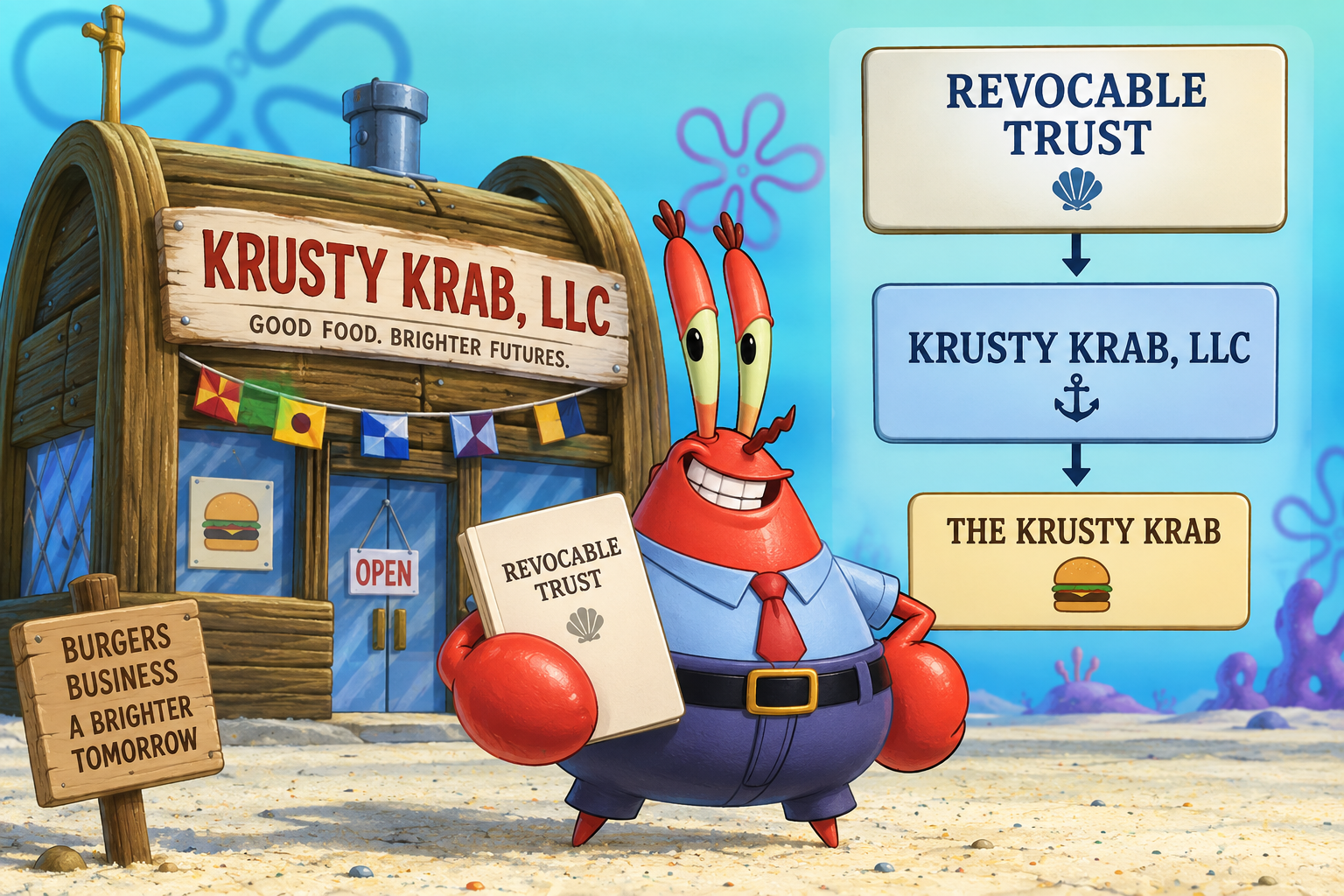
As with most legal rules, the actual situation depends upon how the assets are owned. If Dad and Sarah are joint owners of a bank account, Sarah may already have access to that account because she is an owner. If Dad’s assets are properly titled in a revocable living trust, a successor trustee may be able to step in and manage those assets under the terms of the trust. A representative payee may have authority over certain Social Security or other federal benefits.
But notice what these examples have in common. The authority comes from some preexisting legal arrangement. It does not come from being Dad’s daughter.
And a Pay On Death (POD) designation does not solve the problem either. If Dad names Sarah as payable-on-death beneficiary of his bank account, Sarah generally receives rights to the account when Dad dies. It does not give Sarah authority to manage Dad’s account while Dad is alive but incapacitated.
Death and incapacity are two different estate-planning problems. A good plan should address both.
“I Already Have a Will”
Great. But your Will answers a different question.
Your Will primarily deals with what happens to your probate property after you die. A Power of Attorney deals with something that can be equally important: What happens if you are still alive but cannot manage your own financial affairs?
You can have the greatest Will ever written. You can identify exactly who receives every dollar you own. You can nominate the perfect Personal Representative. You can have everything signed, witnessed, notarized, organized, tabbed, and sitting beautifully in a binder.
And none of that necessarily gives your daughter authority to walk into your bank tomorrow while you are alive and incapacitated. That is a different job. That is why a complete estate plan is more than a Will.

A Power of Attorney Is Really a “While I’m Alive” Document
People tend to associate estate planning with death. But some of the most important estate-planning documents have nothing to do with dying. A financial Power of Attorney is one of them. It is a document for life. It answers a very practical question: If something happens to me tomorrow, who can legally step into my shoes and handle my financial affairs?
Not who wants to. Not who should. Not who everyone in the family agrees would be best. Not who owns the most mustard-colored shirts. Who actually has the legal authority?
That distinction matters.
The Simple Problem That Can Become an Expensive Problem
People sometimes hesitate to spend money on estate planning because they are not sure they will ever need the documents. I understand that. Nobody wants to pay for paperwork unnecessarily. But a Power of Attorney is one of those documents where solving the problem before incapacity can be dramatically easier than solving it after incapacity.
Before incapacity, we prepare the document. You decide whom you trust. You decide what authority that person should have. You sign it properly. Then hopefully it sits in a folder for the next twenty years and nobody ever needs it.
That is actually a good outcome.
After incapacity, however, the conversation may involve doctors, medical certificates, attorneys, court filings, interested persons, hearings, guardianship, inventories, accountings, and ongoing judicial supervision.
The document that “never got used” can look pretty valuable compared with the court proceeding the family may need because it never existed.
Final Thoughts
Dwight Schrute spent a lot of time worrying about whether he was Assistant Regional Manager or Assistant to the Regional Manager. It was funny because, to Dwight, the distinction mattered enormously.
When it comes to your finances, the distinction between someone who is expected to be in charge and someone who has legal authority to be in charge matters even more.
Your spouse may know everything about your finances. Your daughter may be incredibly responsible. Your son may know exactly what you would want. Your entire family may agree about who should handle things. But agreement is not authority.
And unlike Michael Scott, you cannot just walk into the conference room and declare someone your financial agent. You need to actually give that person the authority. That is what a Power of Attorney does.
And perhaps the most important thing to remember is this: You generally need to create it while you still have the ability to create it. The goal is not to give up control. The goal is to decide, while the decision is still yours, who will have the authority to help you if there ever comes a time when you cannot handle things yourself.
Because when that day comes, you want your family’s Dwight Schrute to be more than Assistant to the Financial Manager. You want the paperwork to say that person is actually in charge.









Leave A Comment