

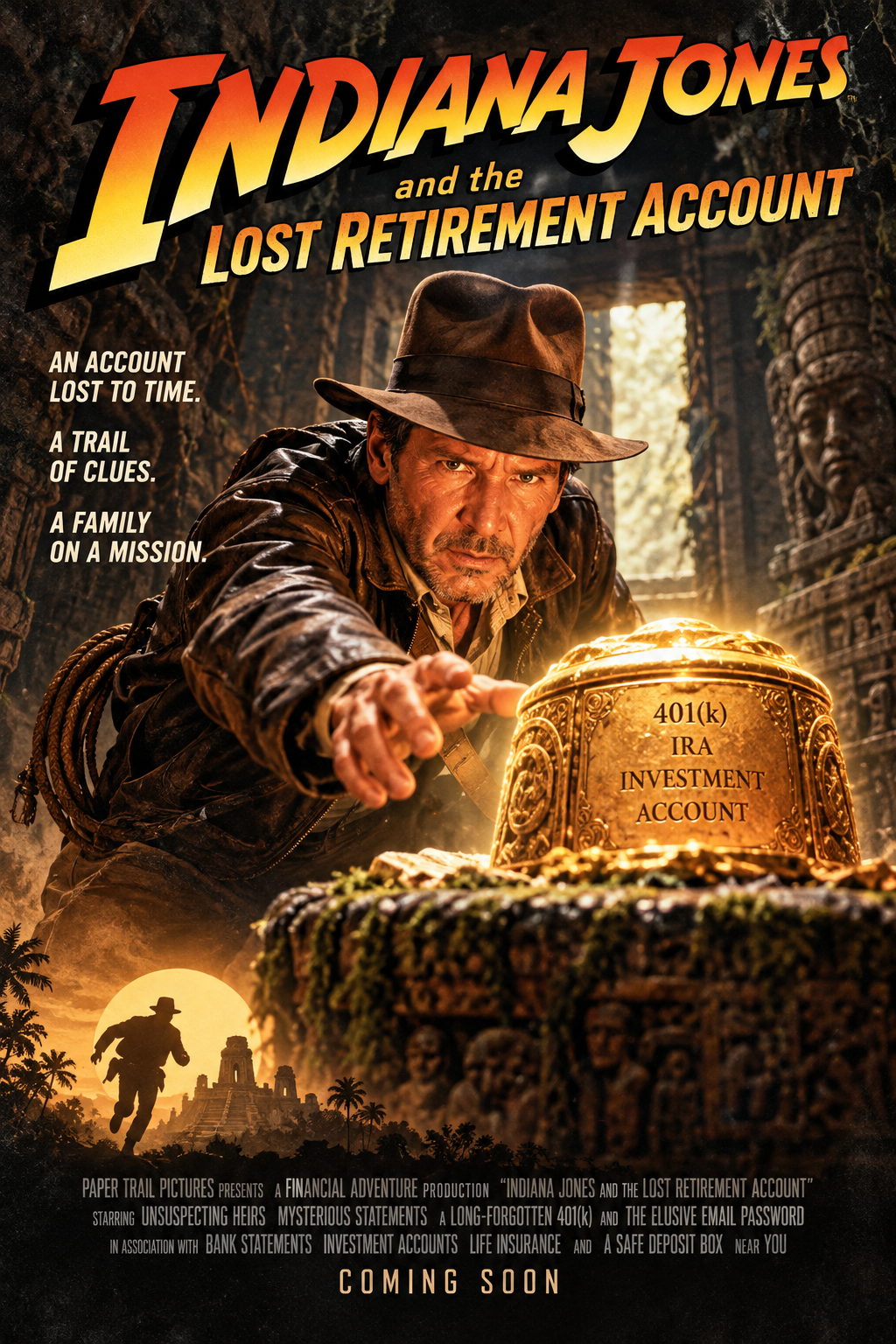
Finding the Dead Guy’s Stuff.
This is a part of estate administration that nobody talks about very much.
I don’t mean going through the garage looking for the lawn mower. I mean figuring out what the person actually owned.
Where did Dad bank? Did Mom have an investment account? Was there an old 401(k) from a job she left 20 years ago? Who holds the mortgage? Is there life insurance? Where is the deed to the house? Did Dad have cryptocurrency? What credit cards did he use? Where are the tax returns? What bills are automatically being charged to his credit card every month?
And increasingly: What is his email password?
Nowadays, most (if not all) of our financial life doesn’t arrive in the mailbox anymore.
Bank statements are electronic. Investment statements are electronic. Bills are electronic. Insurance policies may be electronic. Tax documents may be electronic. Some accounts may exist almost entirely online.
When you die, somebody has to figure all of this out. And unless you’ve made some preparations, that somebody may find themselves starring in a real-life version of Indiana Jones and the Lost Retirement Account.
Except there’s no Harrison Ford. No exotic locations. No ancient treasures.
Just your daughter sitting at the kitchen table, surrounded by old bank statements, wondering why Dad had seventeen different passwords written on scraps of paper and none of them work.
And unlike Indiana Jones, she didn’t volunteer for this adventure.
“My Kids Will Figure It Out”
They probably will.
Eventually.
But consider what you’re asking them to do.
Imagine that I dropped you into somebody else’s financial life tomorrow morning and told you: Find everything they own.
You can’t ask them any questions.
You don’t know which bank they use. You don’t know whether they have one investment account or six. You don’t know where they worked 25 years ago. You don’t know whether they bought a life insurance policy in 1998.
You don’t know their passwords.
You don’t know which bills are automatically deducted from which accounts.
You don’t even necessarily know what you’re looking for.
Good luck.
Indiana Jones at least had clues. Ancient inscriptions. Mysterious maps. The occasional helpful professor. Your kids may have nothing more than a shoebox full of receipts and a vague recollection that Dad once mentioned having an account at Fidelity.
Or was it Vanguard? Or maybe Charles Schwab?
This is one of the most frustrating parts of administering an estate, whether the assets ultimately pass through probate, through a trust, or through beneficiary designations.
Before your family can distribute your stuff, they have to find your stuff.
And you shouldn’t make them conduct an archaeological expedition to do it.

You Don’t Need an Estate Plan to Do This
Obviously, I think having a good estate plan is important.
I’m an estate planning attorney. You probably saw that coming.
But this particular piece of advice has almost nothing to do with whether you have a will or a trust.
You could have the world’s greatest estate plan sitting in a beautifully organized binder.
That doesn’t necessarily tell your Personal Representative that you have an IRA at Fidelity, a savings account at Capital One, an old life insurance policy through Prudential, and a safe deposit box nobody knows about.
A beautifully drafted trust isn’t a treasure map.
Conversely, you could have no estate plan whatsoever and still make life considerably easier for your family by leaving behind an organized record of your financial life.
So do this even if you’ve been putting off your estate planning.
You don’t need a lawyer to prepare the map.
You just need to know where the treasure is buried.
Make a Treasure Map
Not a literal treasure map.
Please don’t make your children decipher a series of cryptic symbols to discover that you have a checking account at Bank of America.
Just make a list of your stuff.
That’s it.
It doesn’t need to be beautiful. It doesn’t need to be prepared by a lawyer. You don’t need special software.
Create a spreadsheet. Create a Word document. Write it in a notebook if that’s what you’ll actually use.
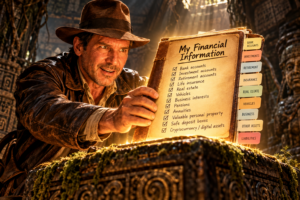
Start with your assets:
- Bank accounts
- Investment and brokerage accounts
- Retirement accounts
- Life insurance
- Real estate
- Vehicles
- Business interests
- Pensions
- Annuities
- Valuable personal property
- Safe deposit boxes
- Cryptocurrency or other digital assets
For each account, identify the financial institution and enough information for someone to know what they’re looking for. Account numbers can be helpful, although there are security considerations about where and how you store this information.
Then list your liabilities and recurring obligations:
- Mortgage
- Credit cards
- Car loans
- Personal loans
- Utilities
- Insurance premiums
- Subscriptions
- Other recurring charges
And don’t forget your digital life.
Because these days, the most important clue in the entire treasure hunt may not be hidden in a dusty old filing cabinet.
It may be sitting in your email inbox.
Your Email May Be the Map to the Lost Ark
Think about how you conduct your own financial life.
When your bank needs to contact you, where does it send the message?
Your email.
When your credit card statement is ready?
Email.
When your insurance premium is due?
Email.
When your investment company sends a notice?
Email.
For many people, access to their email account may provide an extraordinary amount of information about their financial lives.
Your daughter might spend three weeks searching for evidence of an old life insurance policy, only to discover that the insurance company has been sending you annual notices by email for the past fifteen years.
The treasure was there all along.
She just didn’t have the map.
Now, that doesn’t mean you should write your Gmail password on a Post-it note and stick it to your monitor.
Nor does it mean that possessing someone’s password automatically gives you legal authority to access their accounts. Digital access can involve privacy laws, service-provider rules, and other restrictions.
But you should have a secure system for storing important login credentials and make sure the appropriate person knows how to obtain lawful access to the information when necessary.
That might involve a password manager, secure digital vault, or another appropriately protected method. Some online services also offer tools for designating a person to receive certain information after your death.
The important thing is to think about the problem while you’re still here to solve it.
Don’t make your family search for the Lost Ark when you could have simply told them where you put it.
Yes, This Is a Pain in the Ass
This is where I lose people.
Because making this list sounds terrible.
You have accounts scattered everywhere. You don’t remember all the account numbers. You have to look things up. You have to find passwords. Then, once you’ve finally created the list, I’m going to tell you that you should update it periodically.
What a pain in the ass.
I agree.
But here’s the thing.
Indiana Jones spent his career searching for lost treasures because that’s what he wanted to do.
Your kids probably have other plans.
They have jobs. Families. Responsibilities. Their own bills to pay. Their own lives to manage.
And now, because you didn’t want to spend a Saturday afternoon organizing your financial information, they’re supposed to become amateur archaeologists.
Except instead of searching for the Ark of the Covenant, they’re searching for your 2004 rollover IRA.
Instead of dodging poison darts, they’re navigating automated customer service menus.
Instead of escaping a giant rolling boulder, they’re trying to convince a financial institution that they’re authorized to receive information about an account they can’t even identify.
And the worst part?
They can’t call you and ask where you put the map.
You’re dead.
You can’t tell them where you bank. You can’t remember that old retirement account. You can’t explain that the weird $147 charge appearing every month is an insurance premium. You can’t tell them that the password manager is on your phone or that the key to the safe deposit box is in the top drawer of your desk.
That’s the job you’re leaving for your family.
The inconvenience doesn’t disappear because you didn’t want to deal with it.
You’re just transferring it to somebody else.
And you’re making it much harder.

Your Family Will Already Have Enough to Deal With
There is another part of this that is easy to overlook.
The person trying to reconstruct your financial life probably isn’t doing it under ideal circumstances.
They may have just lost their mother.
Or their father.
Or their spouse.
They’re planning a funeral. They’re calling relatives. They’re cleaning out a house. They’re dealing with lawyers, banks, insurance companies, government agencies, and paperwork they may never have seen before.
And they’re grieving.
This isn’t a Hollywood adventure.
There’s no dramatic musical score playing in the background as your son discovers a mysterious envelope containing the location of your missing brokerage account.
There’s just a tired, grieving person trying to get things done.
And probably wondering why you couldn’t have written some of this stuff down.
A little organization today can eliminate an enormous amount of frustration later.
It may also help your family identify assets they otherwise wouldn’t know existed.
Because unlike the movies, there’s no guarantee that all the treasure will eventually be found.
Don’t Make Them Curse Your Name From the Grave
You don’t need to spend the weekend creating a 97-page manual entitled Everything Anyone Could Possibly Need to Know After My Death.
Just start.
Make a list of your bank accounts.
Then your investment accounts.
Then your retirement accounts.
Write down where your important documents are located.
Figure out how the appropriate person will obtain access to important digital information when the time comes.
Tell somebody you trust where this information can be found.
And update it occasionally.
Will this take some time?
Yes.
Will it be annoying?
Probably.
But someday, somebody you love may be sitting at your kitchen table trying to figure out what you owned, where you kept it, and what they’re supposed to do next.
Indiana Jones made a career out of searching for lost treasures.
Your children shouldn’t have to.
So leave them a map.
They’ll have enough reasons to miss you.
Don’t give them a reason to curse your name from the grave, too.










Leave A Comment