

When Can a Trustee Be Removed in Maryland?
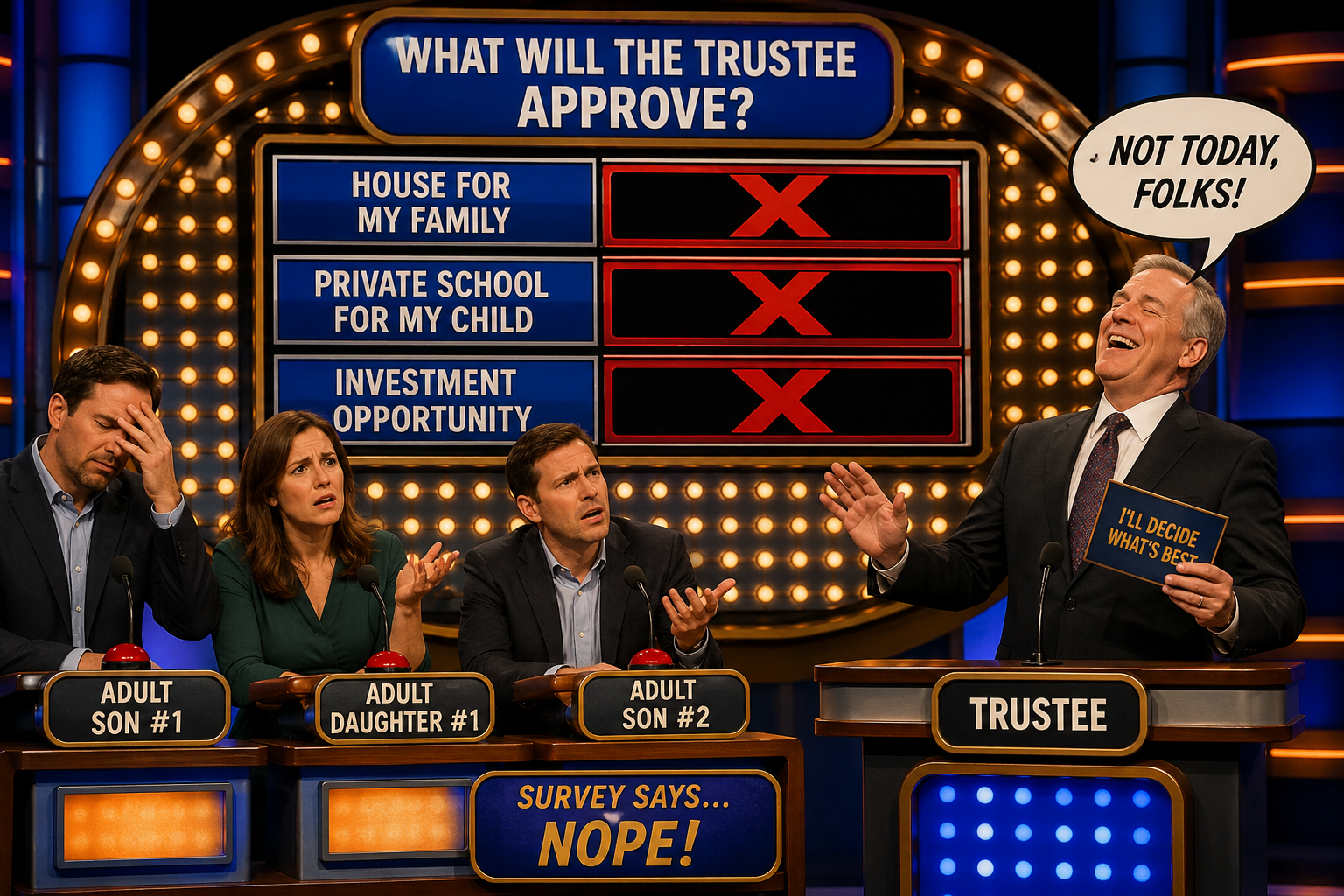
Beneficiaries to a trust whose Trustee is refusing to make distributions can sometimes feels like contestants on a game show where everything they say is wrong or rejected and the host keeps changing the rules.

Of course, that is only one side of the story.
Many trustees are doing exactly what they are supposed to do. Sometimes beneficiaries ask for distributions that are not permitted under the trust. Sometimes a trustee’s answer really is “no.”
But when a trustee consistently refuses to communicate, refuses to provide information, refuses to follow the trust document, or refuses to make distributions that the trust requires, beneficiaries often begin asking an important question:
“Can we remove him?”
The answer is yes.
But not simply because the beneficiaries are unhappy.
One of the most common misconceptions in trust administration is that a trustee can do whatever he or she wants.
That is not the case.
Under Maryland law, trustees have significant responsibilities, and when those responsibilities are ignored, the court has the authority to step in.
Trustees Have Serious Responsibilities
Many people think of a trustee as little more than a person holding money for someone else.
In reality, a trustee occupies a special legal position known as a fiduciary.

A fiduciary is someone who is entrusted to act for the benefit of another person rather than for their own benefit.
Think of Alfred Pennyworth from the Batman stories. Alfred may have access to Bruce Wayne’s home, finances, secrets, and resources, but those things don’t belong to Alfred. His role is to protect Bruce’s interests, not his own.
A trustee operates under a similar principle.
The trust assets may be under the trustee’s control, but they do not belong to the trustee. The trustee’s job is to administer the trust according to its terms and for the benefit of the beneficiaries.
Maryland law imposes a number of important duties on trustees, including:
- Administering the trust according to its terms
- Acting solely in the interests of the beneficiaries
- Treating beneficiaries fairly and impartially
- Keeping adequate records
- Providing information to beneficiaries when required
- Distributing trust assets when distributions become due
In other words, a trustee is not free to make up the rules as they go.
The trust document is the roadmap.
The trustee’s job is to follow it.
When Can a Trustee Be Removed?
Maryland law allows a court to remove a trustee in certain circumstances.
While every case is different, removal is generally appropriate when a trustee has:
- Committed a serious breach of trust
- Become unfit to serve
- Demonstrated an unwillingness to carry out trustee duties
- Persistently failed to administer the trust effectively
- Otherwise acted in a manner that makes removal necessary to protect the beneficiaries
Importantly, the court must also determine that removing the trustee would serve the best interests of the beneficiaries.
This means that removal is not automatic.
The court looks at the entire situation and decides whether replacing the trustee will improve trust administration and better protect the people the trust was created to benefit.

What Does a “Serious Breach of Trust” Look Like?
Not every mistake is a serious breach.
Trustees are human.
They can make reasonable errors without being removed.
But certain conduct raises much more serious concerns.
Examples may include:
Refusing to Follow the Trust Document
Perhaps the most fundamental duty of a trustee is to follow the trust.
That sounds obvious, but disputes often arise when a trustee decides that they know better than the person who created the trust.
Maybe the trustee thinks the trust terms are unfair.
Maybe family members pressure the trustee to distribute assets differently.
Maybe the trustee believes the deceased would have changed their mind if they had updated the documents.
None of that matters.
The trustee’s obligation is to follow the trust that actually exists—not the trust they wish existed.
Refusing Required Distributions
Some trusts give trustees broad discretion.
Others do not.
Many trusts contain provisions stating that assets shall be distributed upon the occurrence of a specific event.
When that happens, the trustee’s role is generally to carry out the distribution—not to decide whether it should happen.
A trustee who refuses to make a required distribution may be exposing themselves to significant legal risk.
Failing to Communicate
Beneficiaries are not entitled to know every detail of a trustee’s day.
They are, however, entitled to certain information regarding the trust and its administration.
When months or years pass without meaningful communication, beneficiaries often begin to wonder whether something is wrong.
Sometimes there is.
Favoring One Beneficiary Over Another
Family dynamics can be complicated.
A trustee may be closer to one beneficiary than another.
They may have old grudges.
They may have personal opinions about who “deserves” more.
Those personal feelings are generally irrelevant.
Trustees have a duty to act impartially and to respect the interests of all beneficiaries.
Using Trust Assets for Personal Benefit
This is one of the clearest examples of a breach of fiduciary duty.
Trust property belongs to the trust—not the trustee.
When trustees treat trust assets as their own, courts tend to take a very dim view of the situation.
Not Every Disagreement Justifies Removal
This is where many people are surprised.
A beneficiary may strongly disagree with a trustee and still have no basis for removal.
For example:
- A beneficiary dislikes the trustee personally
- A beneficiary disagrees with an investment decision
- A beneficiary thinks distributions should be larger
- Family members simply do not get along
Those situations can certainly create tension.
But courts generally do not remove trustees merely because family members are frustrated or unhappy.
Removal is considered a significant remedy and is usually reserved for situations involving genuine misconduct, inability to serve, or substantial failures in administration.
- A trustee is not required to approve every request that comes across the podium.
- Sometimes the trust gives the trustee discretion.
- Sometimes a requested distribution falls outside the purposes of the trust.
- Sometimes the answer really is “no.”
The question is not whether the beneficiaries received the answer they wanted. The question is whether the trustee is exercising authority consistent with the terms of the trust and the duties imposed by law.
Sometimes the Problem Is Different: There Is No Trustee
Occasionally, the issue is not that the trustee is doing a bad job.
The issue is that nobody is doing the job at all.
Imagine a trust names a successor trustee.
When the time comes to serve, that person never accepts the position.
They never resign.
They never formally decline.
They simply disappear or fail to act.
In those situations, Maryland law provides mechanisms for filling vacancies in trusteeship and, when necessary, allows the court to appoint a replacement trustee.
This is an issue that often catches families off guard.
Everyone assumes somebody is in charge—until they discover that nobody actually is.
The Real Goal Is Protecting the Beneficiaries
Most trustees work hard and faithfully carry out their responsibilities.
Many serve without compensation and devote substantial time and energy to helping family members navigate difficult circumstances.
But trustees are fiduciaries.
And fiduciaries are accountable.
When a trustee refuses to follow the trust, refuses to communicate, improperly favors certain beneficiaries, or otherwise fails to carry out their duties, Maryland law provides remedies.
In appropriate cases, those remedies may include removing the trustee and appointing a successor.
The key question is not whether the beneficiaries are unhappy.
The key question is whether the trustee has failed to fulfill the obligations that come with the position.
Final Thoughts
Serving as a trustee can be a difficult and thankless job.
But it is also an important one.
If you have been named as trustee, it is critical to understand your responsibilities before problems arise.
Likewise, if you are a beneficiary and believe a trustee is not carrying out their duties, it is important to understand that you may have options.
Every situation is unique, and the answer often depends on the specific language of the trust and the facts involved.
Does This Affect Your Estate Plan?
Whether you are serving as a trustee, have concerns about a trustee’s conduct, or are creating an estate plan and deciding whom to name as trustee, thoughtful planning can prevent many of these disputes before they start.
If you would like to discuss trust administration, trustee responsibilities, or estate planning in Maryland, we would be happy to help.












I really appreciated the clear breakdown of fiduciary duties under Maryland law, especially the Alfred Pennyworth analogy. I have a question regarding a situation where a trustee might be compromised due to outside activities. If a trustee is heavily involved in high-risk online activities or platforms—for instance, if they are mismanaging personal or trust funds on sites like guiadeVbetbrasil.com—could that pattern of financial instability and potential exposure to scams be used as evidence of them becoming “unfit to serve,” even if a direct breach of the specific trust assets hasn’t been fully proven yet?