

The 3 Legal Documents Every Parent Should Have Before Their Child Leaves for College
When Anthony’s phone vibrated at 3:23 a.m., he braced for news about his aging father.
But as his mind cleared from sleep, he realized the call was about his daughter. Her roommate’s trembling voice delivered the news: an ambulance had rushed her to a hospital, though she does not which one, after she was found unresponsive in her dorm room.
In my legal practice working with Maryland families, I have seen countless situations where proper planning made all the difference during life’s major transitions. But nothing quite captures a parent’s attention like this reality: when Anthony called the all of the area hospitals in a panic, staff refused to confirm whether his 19-year-old daughter was even there.

Despite paying her tuition bills and health insurance premiums, Anthony had no legal right to information. His daughter — though forever his little girl in his eyes — was now an adult under the law.
Without proper documentation, discussing her condition could expose the hospital to serious HIPAA penalties. Anthony spent two agonizing hours in limbo before his daughter regained consciousness and authorized the hospital to speak with him.
Why Turning 18 Changes Everything
Over the past several months, I have been speaking at Maryland high school PTA meetings about this exact issue. I usually begin with a simple question:
“Who here thinks parents can make medical decisions for their 18-year-olds in an emergency as long as the teen lives with them or is dependent on them?”
A lot of hands goes up.
Then I explain the reality: once your child turns 18, you lose automatic authority to make medical, financial, and educational decisions for them — even if they still live at home, remain on your insurance, or depend on you financially.
This catches many parents completely off guard.
The issue becomes even more important when you consider the realities of college life. A 2024 survey found that 70% of students reported struggling with mental health challenges after starting college. Another study revealed that while 41% of students reported experiencing depression, only 22% of parents believed their child was struggling.
Parents are often the last to know when something is wrong.
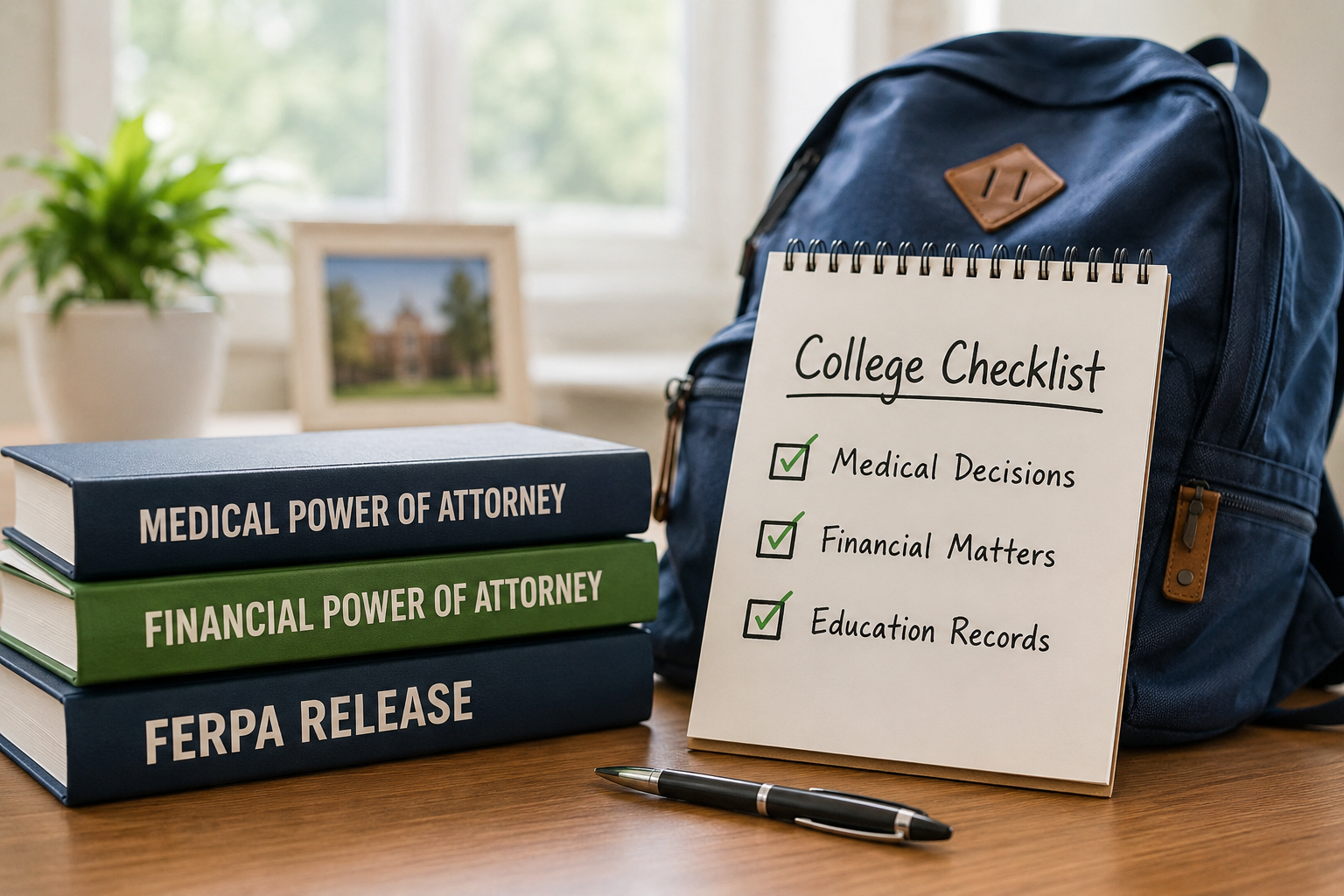
Fortunately, this vulnerability is largely preventable with three straightforward legal documents.
1. Medical Power of Attorney and HIPAA Authorization
This is the document that could have spared Anthony hours of fear and uncertainty.
A Medical Power of Attorney, combined with a HIPAA Authorization, allows healthcare providers to communicate with you and permits you to make medical decisions if your child becomes incapacitated.
Without these documents, hospitals and medical providers are often legally prohibited from discussing your child’s condition with you — even during emergencies.
This issue extends beyond physical emergencies. In many situations involving mental health concerns, parents may suspect something is wrong but find that medical providers cannot legally confirm concerns or share information without authorization from the student.
Most parents will hopefully never need to rely on these documents. But if an emergency does occur, having them in place can prevent unnecessary delays, confusion, and legal barriers during an already stressful moment.
2. Durable Financial Power of Attorney
College students are learning independence, and financial issues inevitably arise.
Debit cards get lost. Fraud alerts freeze accounts. Tuition payment issues occur. Leases become complicated. Insurance claims need to be handled.
A Durable Financial Power of Attorney allows a trusted parent or other adult to assist with these matters when necessary. 
This is not about undermining a young adult’s independence. It is about practical protection.
I have seen situations where a college student was hospitalized after an accident and parents could not access bank accounts, communicate with landlords, or resolve financial issues while the student recovered. Small problems quickly became major disruptions simply because no one had legal authority to help.
A properly drafted Financial Power of Attorney creates a safety net that allows families to step in when needed and keep manageable issues from spiraling into larger crises.
3. FERPA Release
Many parents are surprised to learn that once a child turns 18 or enrolls in college, federal law limits a parent’s access to educational information.
Under the Family Educational Rights and Privacy Act (FERPA), schools generally cannot share grades, transcripts, disciplinary records, class schedules, or other educational information with parents unless the student signs a FERPA release.
Even parents paying the tuition bills may be denied access.
Every college handles FERPA authorization somewhat differently, but most schools provide a simple form that can be completed in just a few minutes.
Having a FERPA release on file can be invaluable if a student experiences academic struggles, disciplinary issues, medical emergencies, or mental health concerns that begin affecting school performance.
A Simple Step Before College Move-In Day
Families who plan carefully already understand the value of preparation.
We purchase insurance, create retirement plans, and put safeguards in place not because we expect disaster, but because preparation is part of responsible decision-making.
 The same principle applies here.
These three documents are not about control. They are about protection, communication, and preserving your ability to help your child when they need you most.
The cost is relatively modest — often just a few hundred dollars for an attorney-prepared package — and the process is usually completed in less than an hour. Some colleges even provide basic FERPA forms free of charge.
Compare that small investment with the alternative: sitting in a hospital parking lot at 3:30 a.m., unable to get information about your child’s condition despite having done everything else right as a parent.
As I often tell parents during my presentations:
Your child’s 18th birthday should not be the day you lose the ability to help protect them.
With the right planning, it does not have to be.












Leave A Comment